
Can a Damaged Stormwater Pipe Be Relined Instead of Digging Up the Yard?
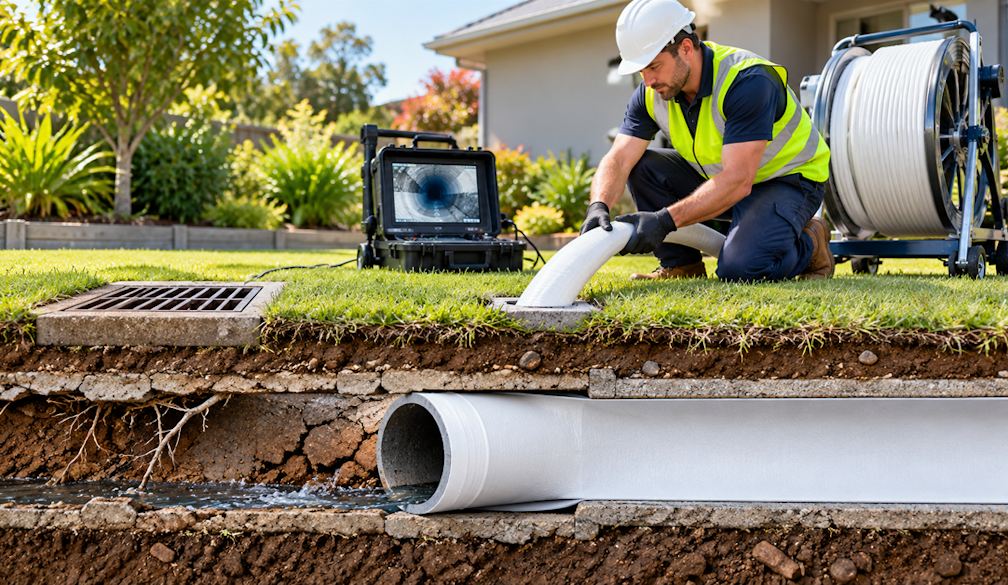
A damaged stormwater pipe often sits in exactly the place homeowners would prefer not to excavate. It may run beneath a driveway, paved entertaining area, established garden or narrow side access. When camera footage shows cracks or root entry, the immediate concern is often how much of the property will need to be dug up.
Stormwater pipe relining can sometimes repair a damaged underground line from the inside, reducing the amount of excavation required. It is not suitable for every fault, and it does not make access irrelevant, but it can be valuable when the existing pipe is damaged yet still retains a workable shape.
Relining uses the existing pipe as the route
Instead of removing the full length of damaged pipe, relining places a new lining material inside the host pipe. Once positioned and cured, the liner forms a new internal surface through the repaired section.
This can seal cracks and damaged joints and reduce future root entry through the treated area. Because the work follows the existing route, large sections of paving or landscaping may not need to be opened.
The old pipe still matters, however. It has to provide a continuous pathway for cleaning, inspection and installation.
The pipe must still have enough shape to accept a liner
A cracked pipe is not the same as a collapsed pipe. Cracks, leaking joints and some forms of root-damaged pipework may be suitable for relining if the line remains reasonably aligned and open.
A severe collapse can make relining impossible because there is no adequate passage through which to install the liner. Major deformation can create the same problem.
This is why a camera inspection is essential before homeowners compare relining with excavation. The decision depends on what the pipe looks like internally, not simply on how disruptive digging would be.
Poor fall is an important limitation
Stormwater pipes rely on gravity to move runoff away from the property. If a section has settled and now holds water, relining generally follows that existing shape.
A liner can create a smoother internal surface but it cannot be assumed to restore the original gradient of a sagging pipe. If poor fall is causing sediment to settle and the line to block repeatedly, excavation and regrading may be required.
Standing water on CCTV footage should therefore be discussed before relining is approved. The plumber needs to work out whether it is caused by a temporary downstream blockage or by the physical level of the pipe.
Preparation often takes as much care as installation
The pipe needs to be clean enough for the liner to be installed against a suitable surface. Roots, silt, loose scale and debris must be removed first.
This cleaning stage can also expose the true extent of the damage. A pipe that initially looks like it has one root-affected joint may show additional cracks after the root mass is removed.
A second camera inspection after cleaning helps confirm the repair length and whether the host pipe remains suitable.
Access is reduced, not eliminated
Stormwater pipe relining is often described as a no-dig solution, but homeowners should understand what that means for their specific property.
The plumber still needs access to the pipe. Existing pits or inspection points may provide suitable entry. In other cases, a small excavation may be required to create access or deal with a local section that cannot be lined.
That can still be far less disruptive than excavating the entire pipe route. The value is especially noticeable under driveways, paved courtyards and established gardens where restoration work would otherwise add significantly to the job.
Compare relining with a local excavation, not with the worst-case scenario
Sometimes a damaged stormwater pipe sits in open soil with excellent access. If only one short section is cracked, a local excavation and replacement may be simple and economical.
Relining becomes more attractive when the affected section is longer or difficult to reach without disturbing valuable surfaces.
The right comparison should include the actual repair scope, preparation, access requirements and restoration work for both options. A homeowner should not choose relining only because excavation sounds unpleasant, just as they should not accept excavation without asking whether a less disruptive repair is technically suitable.
What should you ask before agreeing to relining?
Ask to see the camera footage and have the defect explained. Find out where the repair will start and finish, how the pipe will be cleaned, how access will be achieved and whether any branches connect within the section.
Also ask whether final CCTV footage will be provided after the liner is installed. This can confirm that the new passage is open and the repair has been completed as intended.
If warranties are offered, read the conditions and clarify what they cover. The repair should stand on its technical suitability first, with warranty terms providing additional confidence rather than replacing proper diagnosis.
Think about the rest of the stormwater system too
Relining one damaged section does not automatically solve every stormwater issue on the property. Gutters, downpipes, pits, surface levels and the downstream discharge route still need to work together. If water is being directed toward the wrong area or more paved surface has been added over time, the repaired pipe may still be asked to carry runoff in conditions that were never part of the original design.
For that reason, recurring overflow should be assessed as a route from roof to outlet. The relined section may be the key repair, but it should fit into a system that can collect and discharge water reliably.
Relining is most valuable when it solves the right problem
A cracked stormwater line beneath a driveway and a collapsed pipe in an open garden may produce similar overflow symptoms, but they call for different repair strategies.
Sewer pipe relining can be an effective way to repair suitable cracked or root-affected pipes while limiting disruption to the yard. Its limitations are just as important as its benefits. Severe collapse, major deformation and poor gradient can still make excavation necessary.
The best outcome comes from treating relining as one repair option within a proper diagnosis. If the pipe is suitable, it can preserve surfaces and reduce excavation. If it is not, identifying that early prevents money from being spent on a method that cannot correct the underlying problem.